Showing posts with label the importance of. Show all posts

Saturday, July 9, 2011

The Importance Of: Youtube


In this edition of "The Importance Of" we are going to focus on the "new wave" of technology that has come into prominence....Youtube. Youtube is a site where you can see funny videos, movie trailers, music videos, most importantly people playing music and tons and tons of other things. Back in the long long ago, circa the 90's, if you wanted to learn some new licks, a new song, some new technique you had to seek out other musicians and pick their brain. While I still recommend doing this, Youtube has made it as easy as you can get. If you want any song to listen to and learn you type it in and it pops up. Along with your version is a ton of other versions of the song. If you want someone to show you how to play a song you just punch that it. You can even get musical instruction from everything on how to hold your instrument to how to make chords. This has gave any aspiring and seasoned musicians access to many ways to learn songs and about your instrument of choice. I even use it, as you already know, to post the videos used on this site. Your choices and education with the site are almost endless. As awesome and powerful as Youtube is it has its drawbacks too. While using the site to learn songs from other people, sometimes they are teaching you the wrong thing! As you develope as a musician you will be able to tell what is wrong and what is correct. Sometimes when you are learning something about your instrument it too can be wrong. Another drawback is when you put in a song to learn from an artist the pitch of the song can be altered. I have learned this the hard way by learning a song for a student on Youtube and then at lessons they brought in the original song and the pitch did not match. I have even had some people that you can tell really need instruction for an instrument say "I dont need lessons, I got youtube and the Internet for everything." While these are useful tools sometimes you still need instruction for the reasons, at a minimum, listed above for the drawbacks of Youtube. While there are some drawbacks of Youtube the benefits FAR OUTWEIGH the drawbacks. It is a way to access other musicians and get new ideas and learn a ton of new things. Go check out Youtube, most of you have for sure, and get some new ideas and songs. The best yet, Youtube is free!

here's some examples I find cool, usefull or a drawback.

learn some chords for beginners
http://www.youtube.com/watch?v=mHNvUkeREKM

zakk wylde licks


http://www.youtube.com/watch?v=pwBox7hJNgU

something wrong, if you were to learn this way you would end up a little off
http://www.youtube.com/watch?v=aodql0oOviU&feature=related

Tuesday, May 10, 2011

The Importance Of: Finding New Music


This edition of "The Importance Of" is dealing with how important it is to discover new music. New music does not necessarily mean find the newest, latest band out there. It means finding something that is new to you. It can be something that was released before your parents or grandparents were even born or something you just found on youtube or Pandora. I am someone, that for many years between ages 15-20 years old almost always listened to an hour or two of Pantera everyday. That is not a bad thing, Pantera is awesome! If I would have kept only on Pantera though, I would not have grown as a musician. Listening to and learning songs from something that is new to you can teach you some new tricks. It can inspire you to write songs different. If you only listen to say, country music, it would benefit you to try and listen to some rock. If you only listen to rap , it would benefit you to listen to some prog rock. I have the pleasure of students constantly bringing me lots of new to me music that I would have never thought to listen to. I have a bass student that turned me on to Lakeside. Lakeside has opened up my eyes. It has improved my bass playing. Here is a great Lakeside song http://www.youtube.com/watch?v=GTAqTt2Jjrk

I have also had the pleasure of being turned onto Paramore. This is the song that got me hooked on them http://www.youtube.com/watch?v=-J7J_IWUhls

The only exception is a great song. Discovering new music can get you out of a rut and open your eyes. I love seeing a student discover Bob Dylan or Black Sabbath for the first time. I can see, from the look in their eyes, the look of excitement and joy of hearing masters at work. Go out and discover the "Importance of Finding New Music!"

Monday, December 13, 2010

The Importance Of..................Proper Picking Technique Part #1


The "Importance Of" having a proper picking technique can not be understated. I was having a conversation with a musician buddy this weekend, one who's opinion I greatly respect, and he was talking about someone he knew who needed help with some picking techniques. The way that they were picking in a particular song or two was making it difficult to get the passages played cleanly and evenly. This happens to alot of players. When a guitar player first starts reading about inside, outside, alternate, etc. picking being used by their favorite players, they want to apply it to all aspects of their playing, even when it might not be called for. I am gonna go over some different picking techniques, give examples and do my best to explain them. First let's go through and give definitions of each.

1. Downstroke- picking only going downward
2. Upstroke- picking only going upward
3. Alternate Picking- using upstrokes and downstrokes together
4. Outside Picking- using two string runs so called because as you cross from one string to another the pick strokes come from the outer side of each string pair
5. Inside Picking- using two string runs, so called because the pick, when crossing from one string to another, strikes the area between or inside the two strings
6. Hybrid Picking- using a pick and your fingers
7. Finger Picking- using your fingers to strike or "pick" the strings
8. Sweep Picking- used most of the time with arpeggios. you use the pick to "rake" the strings; the pick "sweeps" the strings. think of the pick falling up and down the strings
9. Legato- means tied together:picking the string one time then doing hammer ons or pull offs on the string smoothly: going note to note only picking once.

example #1 is an example of using downstrokes only. Metallica are the kings of using only downstrokes in their playing. Used with palm muting it can make a riff more powerful. This is a riff that is kinda Metallica-esque. Use all DOWNSTROKES.

example #2 is using only upstrokes. It's based in A minor diatonic. Use all UPSTROKES.

example #3 is using alternate picking. Try and play any Slayer without using alternate picking. Try it . I dare you. You cant do it! This is a Slayer-esque riff. Use ALTERNATE picking.

Just "Click" on the tab paper to make it bigger, if you have trouble reading it.


This is just Part #1 of a two or three part series on Picking Technique. I will have more examples and uses of each kind coming up and a special "Sweep Picking" article in the future by a surprise guest writer. Even though my picking examples so far have used heavy metal type example the techniques described apply to all and every style of music. Have fun with this and see you soon for part #2!!!

Thursday, October 14, 2010

The Importance Of..........Knowing Your Fretboard


This installment of "The Importance Of" is about the importance of knowing your fretboard notes. It does any bass or guitar player good to know where any note is at any given time. Knowing the notes helps you find chords when you want and find the root notes of any scale you want. Its also a big plus to know where everything is at when it is time to rip a solo. When you first look at a guitar or bass it can be over whelming looking at all the frets and strings and wondering how many notes you have to learn. In all reality there really isn't much to learn. If you are good at picking up patterns it's especially a breeze! To help you learn them lets get a couple ground rules first. The first one is knowing that the musical alphabet goes A, B, C, D, E, F, G. Once you get to G it all starts back over at A. What you wind up with is a constant cycle of ABCDEFGABCDEFGABCDEFG. The second rule is every note is a whole step away from every other note except for two notes - E to Fand B to C are half steps (reminder- half step is going up or down 1 fret, whole step is going up or down 2 frets). The third thing is know the name of your strings - (6)low E, (5)A, (4)D, (3)G, (2)B and (1) high E. Knowing our rules you can go up each string without even having a chart.We are going to do natural notes only, meaning NO sharps (#) or flats (b). For both E strings you start out with the open E, go a 1\2 step to the first fret for F, whole step G, whole step A, whole step B, half step C, whole step D and a whole step to the 12th fret to bring you back to E. On your 5th or A string you start out with open A, whole step to 2nd fret B, half step C, whole step D, whole step E, half step F, whole step G, and whole step to A. Your D or 5th string, open D, whole E, half F, whole G, whole A, whole B, half C, whole back to D. The 3rd or G string, open G, whole A, whole B,half C, whole D, whole E, half F and whole G. Your 2nd or Bstring is open B, half C, whole D, whole E, half F, whole G, whole A and whole back to B. We only go to our 12th fret because once you get it down up to your 12th fret you realize its the same from the 12th fret upwards as it was from open to your 12th fret. I am including a fret board diagram in this. It goes along with what we just went over. I have had students get the fret board down by doing what we just did and others get it down by using the diagram and still others by just memorizing what I say in lessons. Any way that works for you is the best way. As long as you get it down it does not matter how you do it or how long it takes you. Learn it front wards,back wards across and any which way you can. It is a very very valuable piece of knowledge and it crucial to becoming a guitar master.To see the fretboard diagram bigger just click on the picture and it will blow up to full screen size.Also for the 4 string bass guitar just get rid of the high E and the B string andthe string numbers change to E-4, A-3, D-2, G-1st string. Hope you get the fret board down and realize "The Importance of Knowing Your Fretboard!"

Friday, September 24, 2010

The Importance Of..................Practicng at Standard Pitch


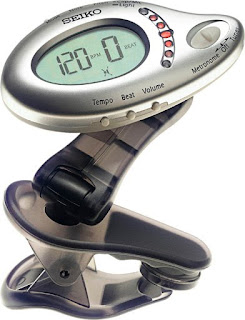
This installment of "The Importance Of" focuses on practicing at standard (440=A) pitch. I'm not talking about band practice or free jamming, I'm talking about when you are going over scales, chords or anything from our lessons. It's important for a variety of reasons. One is that when you hear, say for example, an A note, that you know that it is really an A note. I practiced for years tuned to the tuning i used for my band, 1/2 step down ( low to high- Eb, Ab, Gb,Db, Gb, Bb, Eb), and it made my sense of pitch all whacked out. When i would do my ear training i would always get the note a 1/2 step off!!! Knowing what a note sounds like and being able to tell what it is, is a great tool to have. When you can listen to a song and not have a guitar in your hand and figure it out is awesome!!! I do it alot when i have songs to learn for a fill in gig. Once I started doing all my practicing in standard pitch my ear got nicely fine tuned. When I practiced my scales tuned to 440 I was able to learn solos alot easier. Granted, when I play with my band I still play a 1/2 step down but, I know the note i want to hit that I hear in my head because I know what that note is now!!! So a word to the wise, get yourself a tuner and do all the things I give you to do tuned up to standard pitch!! We have so many tuners at Rock Bottom Music at low prices there is no excuse for you to not be tuned up!!! We have some incredible Seiko tuners, Korg tuners, and the new "snark" and some others i know I am missing. So get a tuner and get to getting that ear and your hands in shape!!

Tuesday, September 14, 2010

The Importance Of...........Finger Exercises


In this segment of "The Importance Of" we are gonna focus on something very specific......finger exercises. It doesn't matter if its your first day playing or you have been playing for thirty years, they are a huge benefit. The first one I start my students off with is the classic "1,2,3,4," exercise. Its where you start with your first finger on the first fret of your low E string, pluck it, go to your second finger second fret, pluck it, then third finger third fret, pluck it, then fourth finger fourth fret, pluck it. You continue this exercise across every string. Once you have made it across go back to your low E string, move up to the second fret and repeat the process. Do this all the way up your neck to the twelth fret.You want to do this and all exercises evenly and smoothly. Make sure every note is clear. You also need to do this with a metronome. Set the metronome to a speed where every "click" is on your one beat.That means every time you hear a click you are moving to the next string. Nothing will get your hands moving better than proper finger exercises that are done properly. They will get you playing better very quickly and are great for warm ups before a gig , band practice or when you are just jamming in your bedroom. I have my exercise sheet posted here for all to see. Feel free to use them. Just remember to start off slowly. Make sure you do them clean. There is absolutely nothing worse than hearing a sloppy player. These will get you un-sloppy. Everyone starts slow. Dont feel like you have to be all macho and play them at a super speed and sloppy. I cant say it enough...DO THEM CLEAN AND IN TIME!!!! You will eventually get them to a fast speed. Remember to have fun with them and never forget "The Imporatnce of Finger Exercises!"

Tuesday, July 27, 2010

The Importance Of..................A Practice Schedule


Welcome to this new installment of "The Importance Of." This time we are going to focus on something very, very important......a regular practice schedule. There are going to be two ways i break this down.

1) for a beginner
and
2) for an established player

Lets start with the beginner. For a beginner you should at the least try for 20 - 30 minutes a day. It might or might not sound like a lot to you. In reality its not,but with families, school, job, etc. it could be. When you first start playing the first 6-12 months are crucial. Why? Because that's when you are developing your hand\finger muscles. You need to do your finger exercises and chord progressions regularly to develop the muscle memory and coordination. You also need to review your chords and have your hands on your instrument as much as possible to help you remember everything. The first 6 months is usually when people give up. Don't be one of those people. Keep at it. Keeping a regular practice schedule WILL GET YOU TO YOUR GOAL OF PLAYING!!!

For the established player try and do an hour a day. That might sound like a lot but again, when you have been playing for a couple years, it's nothing. In that hours time break it off into 10, 15 or 20 minute segments. Make certain days for working on scales. Make others for chords, others for theory, others for arpeggios, etc.. Always make time everyday for exercises. Break your exercises into different groups on different days. Do sweep exercises on Sunday, left hand exercises on Monday, inside picking on Tuesday, outside picking on Wednesday, bends on Thursday, chromatic exercises on Friday, two string exercises on Saturday. That's just an example. Do what works for you, just stay consistent. Always try and push yourself harder and in new directions.

Keeping a regular practice schedule is vital for for all players at all levels on every instrument. I remember in the 90's when grunge came along, alot of players in that time told people that they don't practice and neither should any up and coming players. It was cool then to say you did not practice. There is a place and time to not do exercises and forget everything you learned, we will talk about that later. But to not practice? That's not good. All those awesome players in the 1990's that were telling people not to practice had already spent YEARS practicing. Years practicing, perfecting their chops, honing their craft. Not too many people in the world get good at anything without practice. If you want to become a champion, look at what a champion does to become one.

Tuesday, April 27, 2010

The Importance Of..................


Welcome to the second installment of "The Importance Of." This installment is gonna deal with the importance of listening. Sound weird? Its something you don't normally think about and sounds simple but its something that gets overlooked way to often. There are several ways of listening I am talking about and all are important. The first one is listening to the people you are playing with. That means when you are playing, listen to what they are doing and try and compliment it. Not do your own thing or try and play "against" them. Make sure every ones levels are set right so that everyone can be heard and that your not to loud or to quiet. The second one is, if you are playing a cover song, listen to the subtleties of the song. Even when a band is doing their own version of a song there are, alot of times,key parts and phrases that are very identifiable to the song that you need to be doing. If you are trying to do a "spot on" cover of a song you defiantly need to listen for all the intricacies of the song. Something as small as a little "ping" of a cymbal or a pinch harmonic in a certain spot can be crucial. The third thing? Listen to how you sound when you are laying. Are you in tune? Is your eq out of whack? Are you drums tuned? how does your instrument sound through the p.a. you are playing through? How does your instrument sound in the room you are playing? The next thing? How are people reacting to what you are playing? What do they say? Are they applauding? Are they booing? If you are out playing in public or putting your music out for people to hear, you are automatically putting yourself out there for criticism. Listen to it.Learn from it. Don't get pissed off or overconfident from bad and good criticism. Take it and improve. If you ask for an opinion be prepared for bad answers as well as good ones. There are many things to listen to when you are a musician. These are just a few. So keep your ears open and remember the importance of listening.

Friday, April 9, 2010

The Importance Of............


This is going to be a regular thing I am going to call "The Importance Of." Its going to feature something that is very important to becoming a good musician. The first thing I am going to feature is the metronome. The importance of practicing with one cannot be overstated. You should always use one and it is very critical when first starting out. I have my students use them when doing our finger exercises and chord progressions. It helps you get faster and stronger. It helps you be able to play in time. When using one start off at the speed you can do everything cleanly at, namely your exercises. As time goes on you speed up the beats per minute. If you have a particularly difficult piece to play you can use it to play slowly and then build up your piece of music to the desired speed over a couple days. A metronome can help you get better a whole lot faster than just doing exercises without one. IT IS A MUST HAVE for drummers. If you are a drummer and you cant play steady, you are not a good drummer. It does not matter how many toms,bass drums or how expensive your cymbals are... if you cant play in time you are not gonna be good. That saying goes for every instrument. So go get yourself one. You don't need to spend a whole lot of money on one, $10-$15 should do you. An expensive one does the same thing as a $10 one. You can pick them up on the cheap at any music store. This ends our first installment of "The Importance Of." PEACE